
 24 Mar 2026
 8 min read
 Naveen
Most NRI buyers spend months evaluating properties by price per square foot, developer reputation, and location connectivity. Then they sign a sale agreement without confirming one foundational detail: whether the land they are buying is freehold or leasehold.
That distinction changes everything — what you own, how freely you can sell it, whether your children can inherit it without legal complications, and what happens to your investment in 30 years.
This guide explains both title types clearly, walks through the specific risks leasehold creates for NRI buyers, and shows you how to verify title before committing.
Why this matters:
Freehold is the benchmark against which every other title type is measured. NRI buyers operating remotely have limited ability to manage title complications after purchase. Buying freehold eliminates the largest class of long-term ownership risk before it arises.
Important note:
Not all leasehold properties are legally problematic, and many have been converted to freehold through formal government conversion schemes. The issue for NRI buyers is that verifying lease status, remaining tenure, and renewal history requires legal due diligence that is difficult to conduct remotely.
Risk 1: Residual Lease Tenure Affects Resale Value and Financing
Banks calculate loan eligibility against the remaining lease tenure. A property with 40 years of lease remaining will attract significantly lower LTV (loan-to-value ratio) than a freehold asset. Buyers in the resale market also discount leasehold properties aggressively as the lease shortens, which compresses your exit value precisely when you may need liquidity.
Risk 2: Inheritance Requires Additional Clearances
When a freehold property is inherited, the process involves standard probate or succession procedures. When a leasehold property changes hands through inheritance, many development authorities require the heirs to apply for a formal mutation and, in some cases, a fresh lease sanction. This creates procedural delays and cost that freehold inheritance does not.
Risk 3: Lease Renewal Is Not Guaranteed
Lease renewal policies are set by the holding authority and can change with governments. NRI buyers who purchased a property with a 99-year lease may find, when renewal becomes relevant for their heirs, that renewal terms are significantly more expensive, disputed, or in some cases denied under changed land use policy. This is a category of risk that simply does not exist in freehold ownership.
Red flag to watch:
Any developer or broker who cannot immediately tell you whether the underlying land is freehold or leasehold — and produce the title document to confirm it — is asking you to assume the risk rather than verify it. This is non-negotiable due diligence, not optional paperwork.
Step 1: Obtain the Encumbrance Certificate (EC)
The EC is issued by the Sub-Registrar’s office and records all transactions (sale, mortgage, lien) on the property over a specified period — typically 30 years. A clean EC with no encumbrances confirms the title chain is unbroken and no third-party claims exist.
Step 2: Verify the Patta (Revenue Record)
In Tamil Nadu, the Patta is the revenue document that confirms who holds the land in the government’s records. The seller’s name on the Patta should match the sale deed and EC. Any discrepancy is a title defect that must be resolved before purchase.
Step 3: Check DTCP Layout Approval
For villa or plot purchases in Tamil Nadu, confirm that the layout plan (not just the building plan) has received DTCP approval. DTCP approval confirms the land has been sub-divided and developed in accordance with planning regulations. Without DTCP approval, the property may not be eligible for a home loan, and future resale will be complicated.
Step 4: Confirm Freehold Classification
Ask the developer to produce the original title deed (sale deed / registered document) showing the nature of ownership. Freehold land will be described as an absolute sale with no conditions attached. If any document references a lease, rental, or tenure agreement, engage a property lawyer to review before proceeding.
Pro tip
NRI buyers can conduct much of this verification remotely through a Power of Attorney holder (trusted family member or NRI-specialist property lawyer) who can access documents at the Sub-Registrar’s office and DTCP office on your behalf. Confirm the PoA holder is registered in India and that the PoA is notarised at the Indian consulate in your country of residence.
DTCP approval does not, by itself, confirm freehold title — but DTCP-approved layouts on freehold land represent the strongest combination of legal protections available to property buyers in Tamil Nadu.
OPAL by Infrastride holds full DTCP layout approval for its Kariyampalayam, Annur development.
View the full DTCP and title details at OPAL Land & Legal Documentation →
Resale
Freehold property can be listed for sale without requiring clearance from any development authority. The seller holds the complete title and can transfer it in a single registered deed. Leasehold properties may require NOC from the holding authority before resale, adding time and uncertainty to your exit.
NRI sellers also attract TDS (Tax Deducted at Source) under Section 195 of the Income Tax Act. For freehold properties, the capital gains calculation is straightforward: sale price minus indexed acquisition cost. Leasehold complications can create disputes about what portion of the sale price represents land (leasehold) versus structure, which affects capital gains computation.
Inheritance
Freehold property passes to legal heirs through a will or intestate succession with standard documentation: death certificate, legal heir certificate, and registered transfer. The process is manageable and well-defined.
Leasehold property inheritance may require the heir to apply to the development authority for a transfer of lease — a process with timelines and outcomes that are authority-dependent and not within the family’s control.
| Factor | Freehold Property | Leasehold Property |
|---|---|---|
| Ownership | You own land + structure permanently | You own structure; land held by lessor |
| Expiry Risk | None — title is permanent | Lease expires; renewal not guaranteed |
| Resale Process | Direct sale — no authority NOC needed | May require NOC from holding authority |
| Bank Financing | Full LTV on land + structure value | LTV reduces as lease tenure shortens |
| Inheritance | Standard succession process | May need authority approval for transfer |
| Modification Rights | Full — your land, your call | Subject to lease deed terms |
| Capital Gains on Sale | Clean calculation on full value | Potential dispute on land vs structure split |
| Land Appreciation | Yours to capture independently | Lease value depreciates over time |
| NRI Management Burden | Minimal after purchase | Ongoing lease monitoring required |
Why this matters:
Title issues discovered after registration are expensive and slow to resolve in India’s legal system. Due diligence before signing is the single highest-return action an NRI buyer can take — it costs a fraction of what it costs to resolve a title dispute later from abroad.
Freehold title is not a premium feature for cautious buyers. It is the baseline standard that every NRI property purchase should meet.
The practical reality of NRI ownership — distance, limited ability to respond to administrative processes in real time, reliance on PoA holders, and eventual resale or inheritance — makes freehold title not just preferable but essential.
If you are evaluating properties in Coimbatore, OPAL by Infrastride is built on DTCP-approved freehold land with a clean, verified title chain. The documents are available to review before you commit.
About OPAL by Infrastride:
OPAL is a DTCP-approved, freehold G+1 villa community in Kariyampalayam, Annur, Coimbatore. 2BHK villas from ₹50L (~1,000 sqft on 2 cents) and 3BHK villas from ₹60L (~1,200–2,000 sqft on 3–5 cents). Every villa is built on freehold land with a clean 30-year EC and full DTCP layout approval. NABL Lab Tested construction. The founder lives in the community.
Explore OPAL — Freehold G+1 Villas in Coimbatore from ₹50L
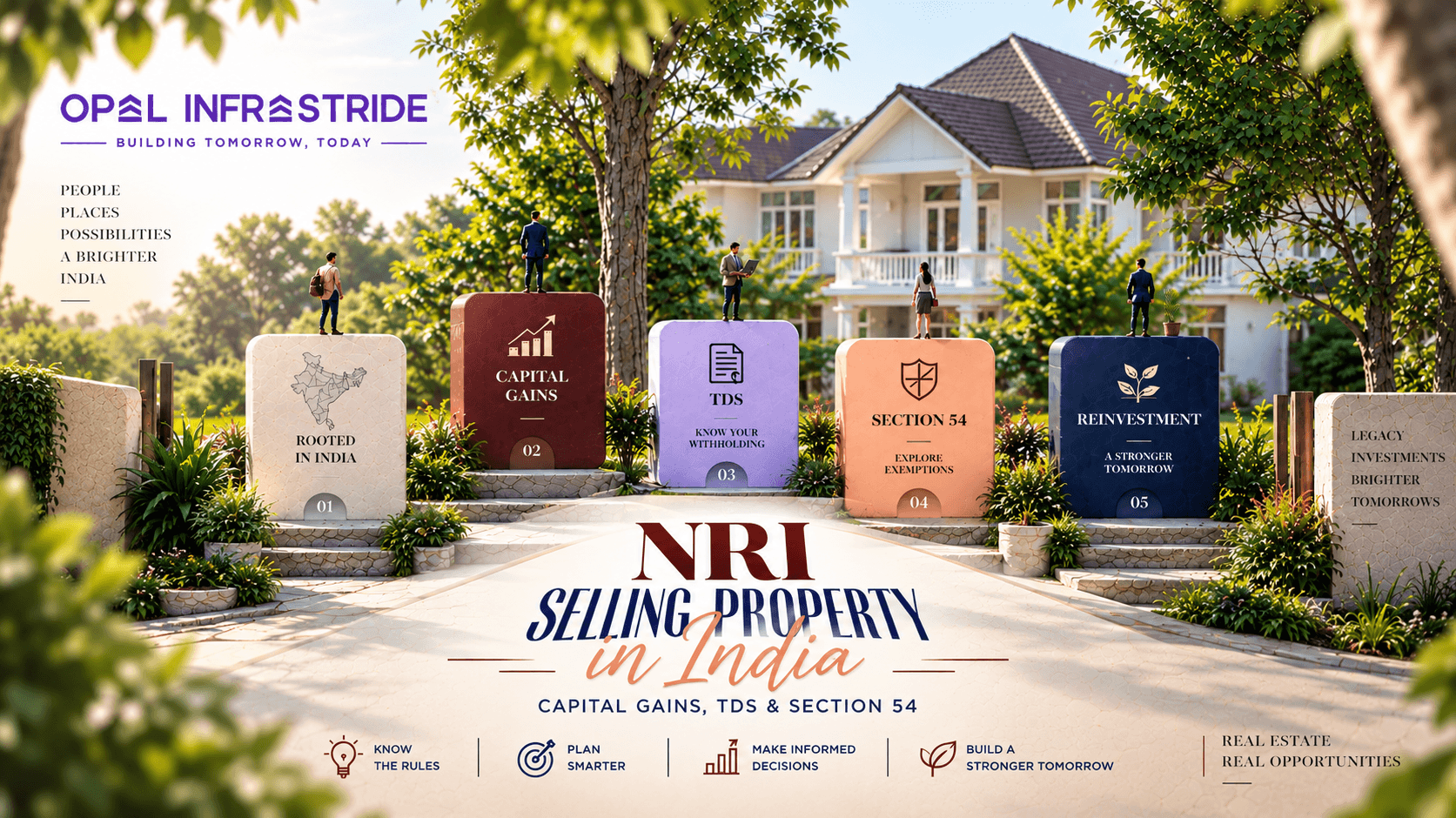
Selling property in India as an NRI costs more than most sellers expect, and for a reason that surprises almost everyone: the tax deducted at the point of sale is calculated on the whole sale price, not on your profit. On an ₹80 lakh sale where you made ₹30 lakh, roughly ₹10 lakh can be withheld rather than the ₹3.75 lakh actually due. That money is recoverable, but only after you file a return — which can be a year later. There are two lawful ways to avoid the gap in the first place, and one of them can remove the tax bill altogether rather than just reduce the withholding. This guide covers what you actually owe, why the withholding works the way it does, the certificate that fixes it, and how reinvestment relief works if you intend to buy again in India.

17 Sep 2026

10 min read

Raja
READ MORE: NRI Selling Property in India: Capital Gains, the TDS Trap and the Section 54 Exemption


If the person selling you a property is a non-resident, the tax obligation is yours. You calculate the deduction, withhold it before paying, deposit it with the government and issue the seller a certificate. Miss a step and the shortfall — plus interest — is recovered from you, not from them. For years that has been heavy enough to break deals. Buying from a resident seller means one online form. Buying from an NRI has meant registering for a TAN and filing quarterly returns, for a single house purchase. That changes on 1 October 2026, and this guide covers what to deduct, on what amount, which form to file, and what the new rule means if you are buying in Coimbatore.
7 Sep 2026
9 min read
Cinegha
READ MORE: TDS on Property Purchase From an NRI Seller: What Buyers Must Deduct, and What Changes on 1 October 2026