
 7 Aug 2026
 9 min read
 Hema
Hema
⚡ The Short Answer
A freehold villa community in Coimbatore gives the buyer absolute ownership of both the villa and the underlying land — no lease expiry, no ground rent, and full inheritance rights. To choose the right one, evaluate on 10 criteria: title type, DTCP or CMDA approval, TNRERA registration, layout quality, road width, water source, community size, common amenities, RWA structure, and long-term maintenance. OPAL by Infrastride at Kariyampalayam is a freehold DTCP-approved G+1 villa community starting from ₹45 lakh.
A freehold villa community in Coimbatore is one of the strongest ownership structures a family can buy into in 2026 — but only if the community itself is well-chosen. Freehold gives you outright ownership, but a poorly planned community can still trap you in narrow roads, weak water supply, chaotic RWA politics, or a builder who exits without handing over common areas. The choice matters. Coimbatore now has more than 40 active freehold villa communities across corridors like Kariyampalayam, Annur, Saravanampatti, Kalapatti, Kovilpalayam, and Avinashi Road — but they vary enormously in layout quality, legal cleanliness, and long-term liveability. This guide gives you a practical, buyer-first evaluation framework you can use to walk any freehold villa community in Coimbatore and score it consistently: 10 evaluation criteria, a side-by-side comparison against leasehold and apartment complexes, the corridor-by-corridor concentration map, and the real long-term cost economics you should plan for. By the end, you will have a repeatable framework to compare any two villa communities and pick the one that actually fits your family.
TABLE OF CONTENTS
10-Point Evaluation Framework for Freehold Villa Communities
| # | Evaluation Criterion | What to Verify |
|---|---|---|
| 1 | Title Type | Freehold on the parent document; 30-year title chain intact; no lease clauses. |
| 2 | DTCP or CMDA Approval | Approval number, layout plan, and online verification match. |
| 3 | TNRERA Registration | Certificate for projects >500 sq m or 8 units; check TNRERA portal. |
| 4 | Layout Quality | Regular plot shapes; road grid; setback compliance; open-space ratio. |
| 5 | Internal Road Width | Minimum 30 ft main roads, 23 ft branch roads; blacktop or CC. |
| 6 | Water Source | Metro/panchayat water + borewell backup; test TDS and yield. |
| 7 | Community Size | 20-60 villas is the sweet spot — big enough for shared costs, small enough to self-govern. |
| 8 | Common Amenities | Compound wall, gate/security, park, drainage, streetlights, underground cabling. |
| 9 | RWA Structure | Registered Resident Welfare Association or defined handover plan post-completion. |
| 10 | Long-Term Maintenance | Written maintenance charges, sinking fund, and 5-year defect liability. |
Score each community on the 10 criteria before signing anything. For the full document-level verification list that pairs with this framework, use our Complete Home Buying Checklist for Coimbatore 2026.
Freehold Villa Community vs Leasehold vs Apartment Complex
| Dimension | Freehold Villa Community | Leasehold Property | Apartment Complex |
|---|---|---|---|
| Land ownership | Absolute, forever | Time-bound (30-99 years) | Undivided share only |
| Loan approval | Fastest, best rates | Slower, discounted LTV | Standard |
| Resale value | Highest appreciation | Depreciates near lease-end | Moderate |
| Inheritance | Automatic, no consent needed | Requires lessor consent in many cases | Automatic |
| Extension / modifications | Full control (within DTCP) | Restricted | Not permitted |
| Common maintenance | RWA-managed, moderate | Landlord-managed | Builder/RWA, higher |
| NRI-friendly | Yes (FEMA-compliant) | Case-by-case | Yes |
For a deeper view of why G+1 villa communities beat apartment complexes on family use-value, see our Why G+1 Villas Are Better Than Apartments in Coimbatore analysis.
For the full corridor-by-corridor ROI ranking that pairs with this concentration map, see the Best Areas in Coimbatore for Real Estate ROI 2026-2031 guide.
Three Cost Layers of Freehold Villa Community Ownership
| Cost Layer | What It Covers | Typical Range |
|---|---|---|
| Purchase cost | Land + villa construction + registration + stamp duty (8% in Tamil Nadu) | ₹45L – ₹1.5Cr all-in |
| Monthly maintenance | RWA fees: security, cleaning, streetlights, drainage, park upkeep | ₹1,500 – ₹4,000 / villa / month |
| Sinking fund | Long-term capital repairs: roads, compound wall, water infrastructure | ₹500 – ₹1,000 / villa / month |
For broader research on India's freehold vs leasehold residential market economics, see JLL India's residential research reports, which track ownership-structure preferences and yield differences across major Indian markets.
The Long-Term View
A well-run freehold villa community with a functional RWA and disciplined sinking fund can hold value and appreciate cleanly for 20-30 years. A poorly evaluated one becomes a liability within 5-7 years — narrow roads, dry borewells, broken drainage, and a defunct RWA are the usual failure modes. The 10-point framework above is the single best investment protection at the entry stage.
A freehold villa community is a group of villas where each buyer owns both the villa and the underlying land in absolute title. There is no lease expiry, no ground rent, and full rights to sell, mortgage, or inherit.
Freehold is absolute ownership forever. Leasehold gives time-bound rights (30-99 years) with ground rent and lessor consent for major changes. Freehold offers better loans, resale value, and inheritance rights.
Yes. Most communities have a registered Resident Welfare Association (RWA) that collects ₹1,500-₹4,000 per villa per month for security, cleaning, park, streetlights, water and drainage upkeep.
Yes. Any layout with more than a threshold number of plots must have DTCP approval (outside CMDA jurisdiction) or CMDA approval (within it). Verify the approval number online before booking.
Yes. NRIs and PIOs can buy freehold residential property under FEMA. Payment must route through NRE or NRO accounts, and a PAN card plus power of attorney to a resident is typically required for registration.
Yes. OPAL by Infrastride at Kariyampalayam is a freehold, DTCP-approved, TNRERA-registered G+1 villa community. Villas start from ₹45 lakh and are structured with a clear RWA handover post-completion.
Our project team will walk you through freehold titles, DTCP layout, TNRERA registration, and the community master plan. Visit infrastride.in or call to schedule.
Book Your Site Visit at OPAL by Infrastride — Kariyampalayam
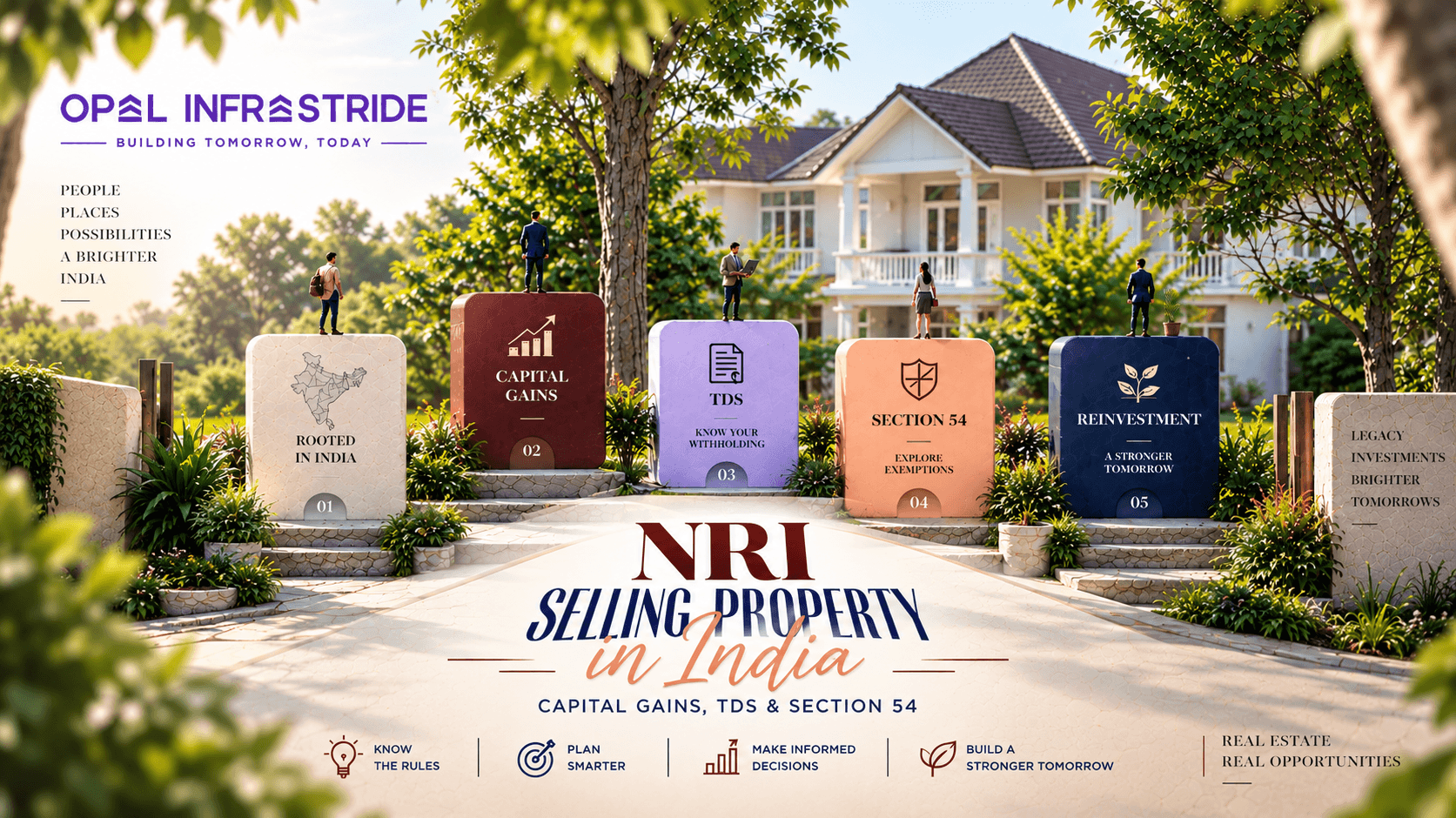
Selling property in India as an NRI costs more than most sellers expect, and for a reason that surprises almost everyone: the tax deducted at the point of sale is calculated on the whole sale price, not on your profit. On an ₹80 lakh sale where you made ₹30 lakh, roughly ₹10 lakh can be withheld rather than the ₹3.75 lakh actually due. That money is recoverable, but only after you file a return — which can be a year later. There are two lawful ways to avoid the gap in the first place, and one of them can remove the tax bill altogether rather than just reduce the withholding. This guide covers what you actually owe, why the withholding works the way it does, the certificate that fixes it, and how reinvestment relief works if you intend to buy again in India.

17 Sep 2026

10 min read

Raja
READ MORE: NRI Selling Property in India: Capital Gains, the TDS Trap and the Section 54 Exemption


If the person selling you a property is a non-resident, the tax obligation is yours. You calculate the deduction, withhold it before paying, deposit it with the government and issue the seller a certificate. Miss a step and the shortfall — plus interest — is recovered from you, not from them. For years that has been heavy enough to break deals. Buying from a resident seller means one online form. Buying from an NRI has meant registering for a TAN and filing quarterly returns, for a single house purchase. That changes on 1 October 2026, and this guide covers what to deduct, on what amount, which form to file, and what the new rule means if you are buying in Coimbatore.
7 Sep 2026
9 min read
Cinegha
READ MORE: TDS on Property Purchase From an NRI Seller: What Buyers Must Deduct, and What Changes on 1 October 2026