
 05 May 2026
 10 min read
 Viji
Viji
Disclaimer:
This article is for informational purposes only and does not constitute architectural, medical, or legal advice. Design specifications, cost estimates, and accessibility standard references are indicative and should be verified with qualified professionals before any decision is made. Building standards and accessibility codes vary by local authority — confirm applicable requirements with your architect or contractor.
Most people plan their home for the body they have today. They do not plan for the body they will have at 70, or 75, or 80. This is not a failure of foresight — it is simply how people think about homes when they are healthy and mobile. The consequence is that most homes, including new ones built to current standards, are not designed to support the people who live in them across a full lifetime.
Universal design is the approach that changes this. It does not mean designing for disability. It means designing for the full range of human capability — recognising that a home which works well at 45 should still work well at 80, without requiring costly modifications, professional assistance, or family intervention for daily routine life.
This guide explains what universal design means in a residential context, which features matter most, and how to evaluate a property for long-term independence — whether you are buying now for retirement, or planning ahead for the next decade.
In practice, residential universal design focuses on five core areas: single-level or lift-accessible layouts, bathroom safety, entrance accessibility, doorway and corridor widths, and flooring and lighting quality. These five areas account for the overwhelming majority of home-related falls, injuries, and mobility limitations experienced by older adults.
Entrance and approach
The entry to the home is the first place universal design is tested. Steps at the threshold, heavy or narrow doors, and poor pathway lighting create friction that worsens with age and becomes a genuine barrier with a mobility aid. A step-free or gently ramped approach, a clear doorway width of at least 900mm, a level threshold, adequate lighting, and lever-style door handles are the baseline standard.
Living areas
Open or semi-open layouts with clear circulation paths allow movement without obstruction. Electrical switches at a consistent height of 900–1,200mm from floor level, plug sockets positioned above floor level, and non-slip flooring with low-contrast texture changes at transitions all contribute to safe and easy navigation. Furniture placement matters as much as the room design itself — a 900mm clear path must be maintained through the space.
Kitchen
Standard kitchen design assumes a standing adult with full reach and grip strength. For long-term use, kitchens benefit from pull-out drawers rather than fixed deep shelving, lever taps, counter heights that work both standing and seated, under-counter knee space for seated operation, and storage concentrated at accessible heights (400–1,400mm from floor level). Non-glare lighting and contrasting colours at counter edges reduce accidents.
Bathroom
The bathroom is statistically the highest-risk room in any home for falls. Wet surfaces, enclosed spaces, and the physical demands of bathing combine to make this the room most in need of careful design. Key features: a roll-in or low-threshold shower with no step-over lip, grab rails at toilet and shower positioned correctly for transfer and balance, a comfort-height toilet (450–480mm seat height), non-slip flooring, a fold-down bench seat in the shower, a handheld showerhead on a slide rail, and sufficient turning radius — minimum 1,500mm diameter clear floor area.
Bedroom
Clear circulation space of at least 900mm on both sides of the bed, accessible wardrobe storage without high shelving, appropriate bed height (500–550mm from floor to top of mattress), and easily reachable light switches at the bedside and doorway all contribute to comfortable, independent bedroom use. Space for a carer’s chair or overnight carer support should be factored in for future planning.
Lighting throughout
Older eyes require significantly more light than younger eyes and adapt more slowly between lit and dark environments. Higher lux levels throughout the home, nightlights in corridors and bathrooms, motion-sensor lighting for nocturnal navigation, and elimination of deep shadows at transitions are all relevant. The approach to the front door and car park area should also be well lit at all times.
Pro tip
When evaluating a property for aging in place, do a test walk through at roughly half your normal pace, with one hand brushing the wall. This approximates movement with a walking aid and will immediately reveal circulation problems, threshold hazards, and reach issues that are completely invisible during a normal property inspection.
Important note
The cost estimates above are indicative and reflect the general market at time of drafting. Actual costs will vary significantly based on property construction type, scope of modification required, and local contractor rates. Obtain detailed quotes from registered contractors before budgeting any retrofit project.
For G+1 villa structures specifically: the ground floor should contain everything required for complete independent daily living — bedroom, bathroom, kitchen, living area — so that the upper floor is optional and supplementary rather than essential.
Pro tip
When viewing a G+1 villa, mentally map whether the ground floor alone meets all daily living needs — ignoring the upper floor entirely. If the answer is yes, the property works for aging in place regardless of what changes happen over time. If any essential function requires the upper floor, that is a design limitation worth understanding clearly before committing.
These technologies do not require a purpose-built home — they can be installed in most properties. But they work best when the underlying home design already minimises physical friction. Technology augments good design; it does not compensate fully for its absence.
Why this matters
For families where an NRI child is the primary support person, remote monitoring technology meaningfully closes the distance. A parent living independently in Coimbatore, a child in Singapore or London — smart home technology provides real-time visibility and emergency response capability without the parent feeling surveilled or the child carrying constant anxiety. Good home design and appropriate technology together create the conditions for confident, genuinely independent living.
| Feature | Apartment | G+1 Villa (Ground Floor) |
|---|---|---|
| Entrance accessibility | Dependent on lift availability and maintenance reliability | Direct ground-floor entrance; step-free approach achievable at construction stage |
| Single-level living | Yes — if all rooms are on the same floor | Yes — ground floor contains complete independent living arrangement |
| Outdoor space | Balcony only in most cases | Private garden or courtyard possible; ground-level access |
| Modification flexibility | Constrained by society rules and shared structure | Full control; modifications possible at any construction or occupancy stage |
| Emergency access | Dependent on lift or staircase functionality | Direct ground-floor access for ambulance, carer, or equipment |
| Carer accommodation | Often not possible without giving up a bedroom | Upper floor can serve as dedicated carer or family space |
| Noise and privacy | Shared walls and shared corridors | Independent structure; significantly lower ambient noise |
| Community | Shared common areas with a larger resident population | Smaller community; closer individual relationships possible |
For buyers who want maximum flexibility to adapt their home as needs evolve over a decade or two, a ground-floor villa unit provides the structural latitude and regulatory freedom that an apartment — even a well-designed one in a well-maintained society — typically cannot match.
Pro tip
Properties purchased during construction offer the most flexibility for universal design modifications: wider doorways, grab rail backing plates embedded in bathroom walls before tiling, specific flooring choices, and threshold adjustments. Once construction is complete, the cost of each change rises significantly and some modifications become structurally constrained. If aging in place is a priority, raise your requirements with the developer during the sales process — not after handover.
| Feature | Purpose-Built | Retrofit (Typical) |
|---|---|---|
| Step-free entrance | Designed in at ground level | Ramp addition; may require drainage and pathway modification |
| 900mm doorway widths | Specified at construction stage | Structural work; often constrained by load-bearing walls |
| Roll-in shower | Designed into wet area from the start; drainage correct | Full bathroom re-work: tile, waterproofing, drainage repositioning |
| Grab rail backing plates | Embedded in walls before tiling | Wall opened, plate fitted, retiled; achievable but disruptive |
| Comfort-height toilet | Specified at fit-out stage | Simple swap if rough-in dimensions permit; low cost |
| Non-slip flooring | Selected at construction; correct specification | Overlay or full re-tile; may raise floor levels at thresholds |
| Lever taps and handles | Specified at fit-out | Simple swap in most cases; low cost |
| Motion-sensor lighting | Wired in during construction; clean installation | Retrofit wiring or battery-operated sensors; visible cabling |
| Ground-floor complete living | Designed into the floor plan | Not achievable if ground floor lacks bedroom or full bathroom |
For NRI families exploring joint ownership at OPAL: OPAL NRI Buyer Information →
About OPAL by Infrastride:
OPAL is a DTCP-approved, freehold G+1 villa community in Kariyampalayam, Annur, Coimbatore. 2BHK ground-floor villas from ₹50L. 3BHK first-floor villas from ₹60L. Ground-floor living designed for independent, single-level occupation. Construction materials tested by NABL-accredited laboratory — full test reports available at each build milestone. NRI joint ownership and co-borrower support provided. The founder lives in the community.
Interested in how OPAL is designed for long-term independent living?
Our team walks you through the ground-floor layout, the universal design options available at construction stage, and how the G+1 structure works for joint family or NRI buyers.
Explore OPAL — Villas for Multigenerational Buyers from ₹50L
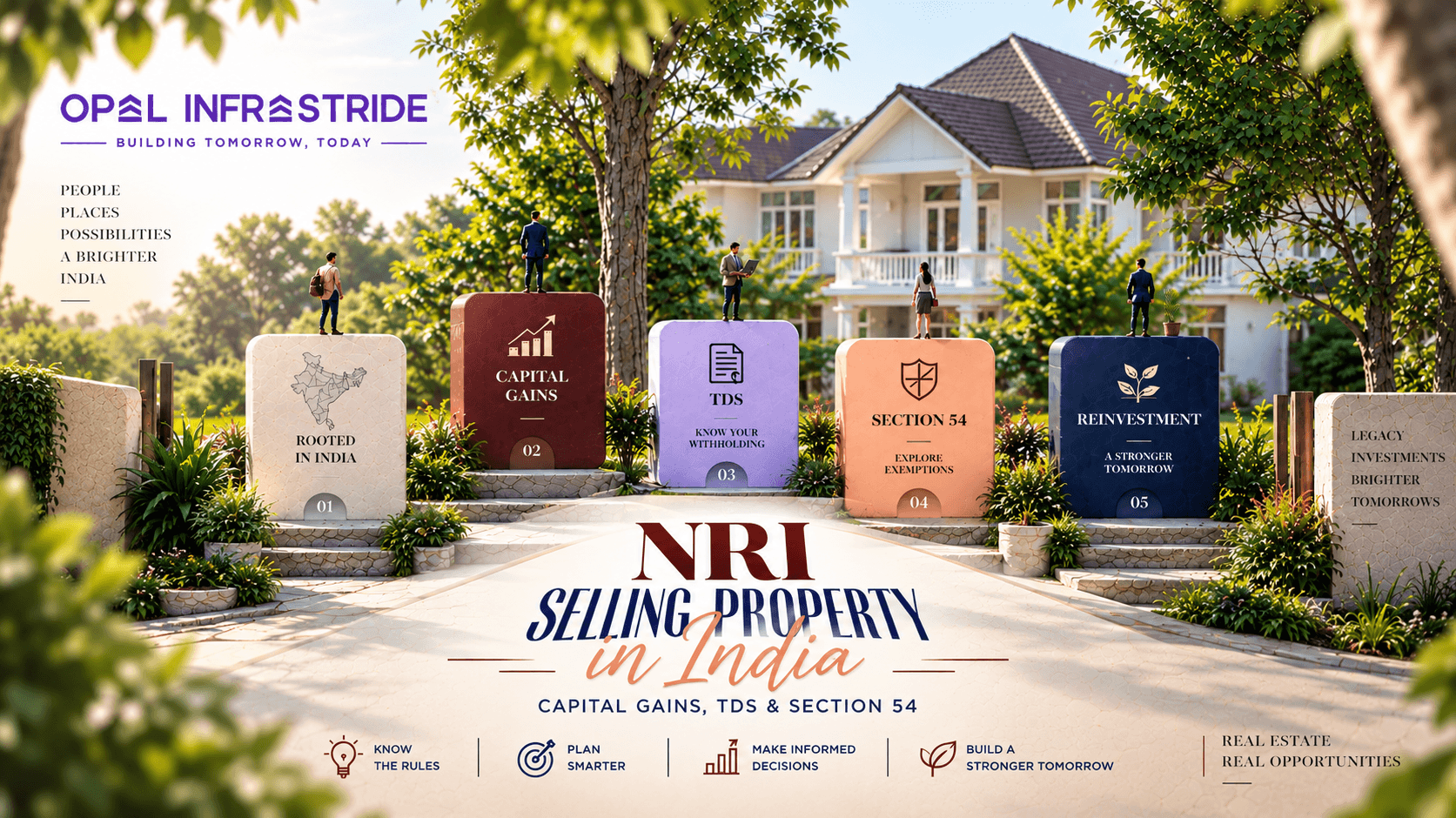
Selling property in India as an NRI costs more than most sellers expect, and for a reason that surprises almost everyone: the tax deducted at the point of sale is calculated on the whole sale price, not on your profit. On an ₹80 lakh sale where you made ₹30 lakh, roughly ₹10 lakh can be withheld rather than the ₹3.75 lakh actually due. That money is recoverable, but only after you file a return — which can be a year later. There are two lawful ways to avoid the gap in the first place, and one of them can remove the tax bill altogether rather than just reduce the withholding. This guide covers what you actually owe, why the withholding works the way it does, the certificate that fixes it, and how reinvestment relief works if you intend to buy again in India.

17 Sep 2026

10 min read

Raja
READ MORE: NRI Selling Property in India: Capital Gains, the TDS Trap and the Section 54 Exemption


If the person selling you a property is a non-resident, the tax obligation is yours. You calculate the deduction, withhold it before paying, deposit it with the government and issue the seller a certificate. Miss a step and the shortfall — plus interest — is recovered from you, not from them. For years that has been heavy enough to break deals. Buying from a resident seller means one online form. Buying from an NRI has meant registering for a TAN and filing quarterly returns, for a single house purchase. That changes on 1 October 2026, and this guide covers what to deduct, on what amount, which form to file, and what the new rule means if you are buying in Coimbatore.
7 Sep 2026
9 min read
Cinegha
READ MORE: TDS on Property Purchase From an NRI Seller: What Buyers Must Deduct, and What Changes on 1 October 2026